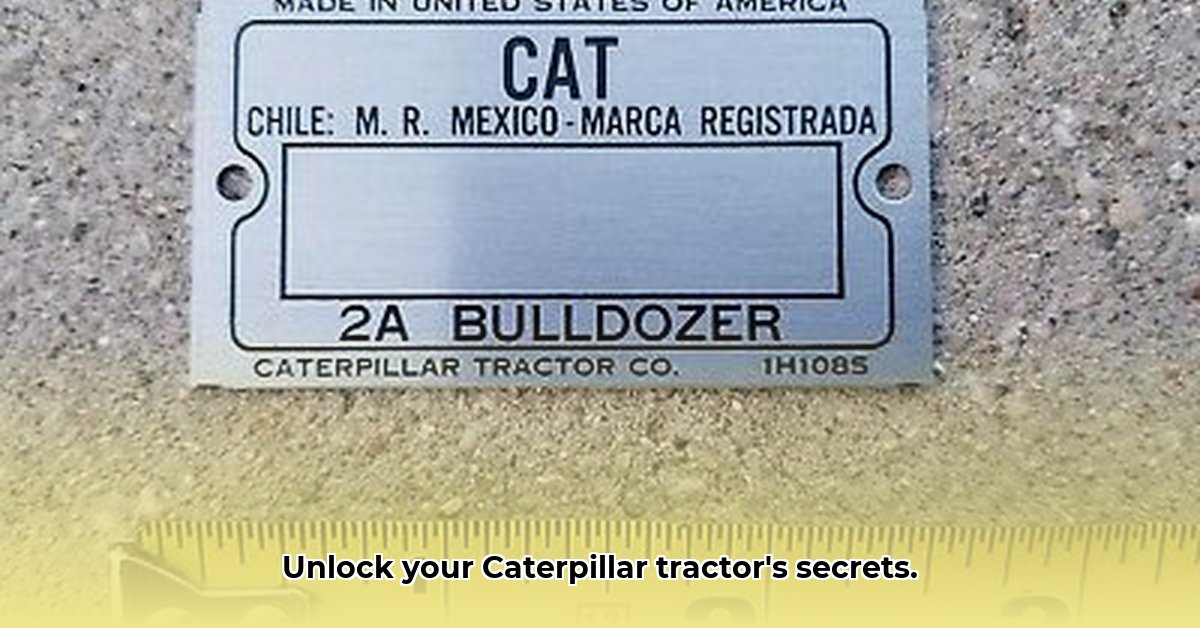
Finding Your Caterpillar Tractor's Serial Number: A Step-by-Step Guide
Locating your Caterpillar tractor's serial number is the first step in understanding its history. This number, a unique identifier, provides crucial information about your machine's model, manufacturing date, and more. But where is it? It's often a bit of a treasure hunt! For similar serial number searches on other brands, check out this helpful resource: John Deere serial numbers.
Step 1: Consult Your Owner's Manual. Your owner's manual should clearly indicate the location of the serial number plate for your specific model. This is the easiest and most reliable starting point.
Step 2: Systematic Visual Inspection. If your manual is unavailable, perform a thorough visual inspection of the entire tractor. Common locations include:
- Near the driver's seat: This is a frequent placement for easy access.
- On the main frame: Often found on a visible metal plate attached to the tractor's structural components.
- Inside access panels: Some serial numbers are hidden under panels or covers.
- Within the engine compartment: Often found on a plate affixed to the engine block itself (note that the engine may have a separate serial number).
Step 3: Investigate Hidden Compartments. Many tractors have small compartments or access points under seats, panels, or in the engine bay that may conceal the serial number plate.
Step 4: Leverage Caterpillar Resources. If you still cannot find the serial number, contacting Caterpillar directly or visiting their website (https://parts.cat.com/en/catcorp/cat-serial-number-identification) might offer solutions. Your local Caterpillar dealer is another excellent resource. They can often assist based on your tractor's model number or other identifying features.
Why is finding the serial number crucial? It allows you to order the correct parts, schedule appropriate maintenance, verify your tractor's authenticity, and even trace its manufacturing history. Is this a critical step? Absolutely!
Understanding Caterpillar Tractor Serial Number Structure
Caterpillar tractor serial numbers aren't random; they follow a structured system that encodes key information. The format evolved over time, so the number's length and the information encoded can vary.
Older Models (typically pre-2001): These often feature 8-digit serial numbers.
Newer Models (generally post-2001): These tend to utilize a 17-digit Product Identification Number (PIN). While a longer string of numbers, the last eight digits usually correspond to the older 8-digit serial number system.
Prefix vs. Suffix: Both older and newer systems consist of a prefix (letters and/or numbers at the beginning) and a suffix (numbers at the end). The prefix often hints at the model, manufacturing location, and the year of manufacture. The suffix acts as a sequential production number. However, a comprehensive, publicly accessible decoder for all prefixes doesn't currently exist.
Deciphering Your Tractor's History: Interpreting the Serial Number
While a complete, publicly available decoder for all Caterpillar tractor serial number prefixes is not readily available. Utilizing some key strategies will help unlock the information.
1. Identify the Prefix: The prefix, the alphanumeric characters at the beginning of your serial number is the key to understanding the model of your tractor.
2. Leverage Online Resources: While complete databases may be lacking, Caterpillar forums and enthusiast websites often contain partial lists and decoding hints. Use caution and verify information from unofficial sources with official documentation.
3. Contact Caterpillar Directly: Caterpillar's official website and your local dealer remain the best sources for accurate interpretations, particularly for less common prefixes.
4. Investigate Component Serial Numbers: Remember that engines and other major components often have their own unique serial numbers. These numbers can further reveal maintenance and component history.
Why is understanding the serial number structure so important? Accurate interpretation streamlines parts ordering, facilitates effective maintenance planning, and provides insights into the machine's journey from factory to field. This is more than just a number; it's a key to your tractor's story.
Troubleshooting Common Serial Number Challenges
Even with careful searching, finding and interpreting the serial number can present obstacles.
Issue 1: Obscured Numbers: Dirt, grime, or wear can make numbers illegible. Clean the plate thoroughly, and if necessary, use a magnifying glass. High-resolution photography could also be helpful.
Issue 2: Multiple Serial Numbers: Some machines have multiple plates. Ensure that you're using the correct serial number for your intended purpose (engine, chassis, etc.).
Issue 3: Missing Serial Number Plate: If the plate itself is missing, contact your local Caterpillar dealership. They can use other identifying information (model number, etc.) to help track down your tractor's details.
Issue 4: Difficulty Deciphering Prefix: This is often the most challenging aspect. Utilize online resources and contact Caterpillar or your dealer for assistance.
Utilizing Caterpillar Resources and Online Communities
While a complete public database doesn't exist, several valuable resources can aid interpretation.
Caterpillar's Official Website: Caterpillar's website is an invaluable source of information, parts catalogs, and potentially service manuals that may contain further details.
Caterpillar Dealers: Your local Caterpillar dealership is a crucial resource. They have access to extensive databases and can provide highly accurate decoding.
Online Forums and Communities: Online communities dedicated to Caterpillar equipment offer a wealth of shared knowledge and may contain user-contributed information on serial number prefixes. However, always verify information found in online forums with official Caterpillar sources.
By combining these methods, you'll be well on your way to decoding your Caterpillar tractor's serial numbers and unlocking its rich history. Remember, persistence and the use of reliable resources are key to success.